

A consumer researcher I follow on Substack posted something recently that's been living rent-free in my head:
She’s right. And I’d even go further.
Selling out of a product means you didn't see it coming. Your data wasn't talking to you, or you weren't listening. Either way, someone wanted to give you money and you turned them away. That's a systems problem wearing a muscle suit.
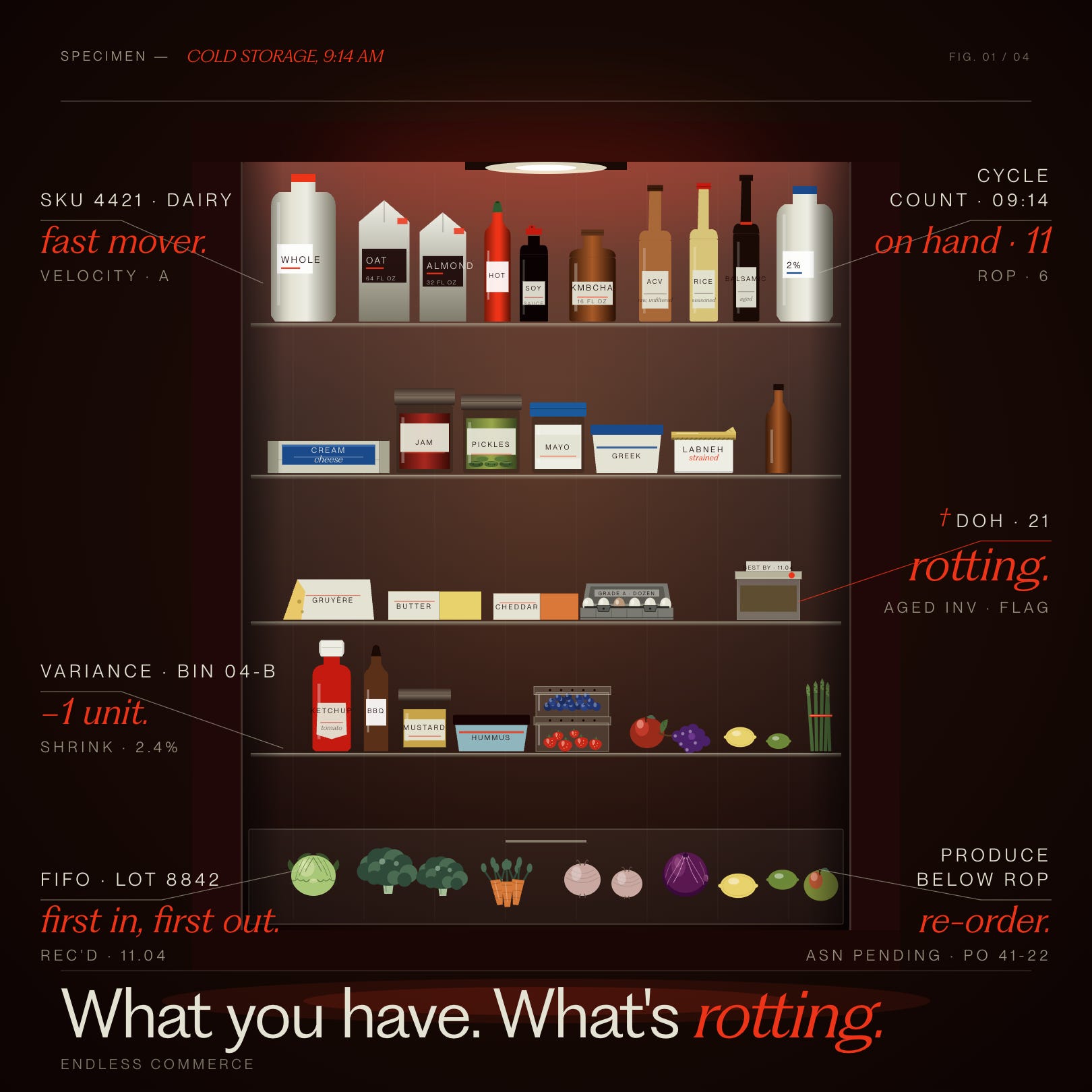
I think about this concept in terms of a fridge.
Stick with me.
A well-managed fridge doesn't have stuff rotting in the back or empty shelves. A great fridge manager (hah!) buys what they'll actually use, rotates it instinctively, and knows what's running low before they're out of eggs on a Sunday morning facing down kids who want pancakes. The goal is the right fridge, with the right things, at the right time.
Your warehouse is your fridge, but bigger and more expensive.
Dead inventory charges you rent every single day: carrying costs, storage fees, opportunity cost. Running out of your hero SKU right when a wholesale account is scaling you up? That's the relationship. Maybe the account.
(I've spent more Sunday nights than I'd like to admit hoping the spreadsheet numbers matched by Monday morning. They often did not.)
Most founders I meet are flying somewhere between those two disasters, adding channels, SKUs, and warehouse locations with gut instinct, a spreadsheet someone made in 2022, and today's vibes. That spreadsheet won't tell you what's committed, what's in transit, or what's not. So you restock reactively instead of intentionally.
It sounds obvious when you say it out loud...but most of the hard operational stuff does.
Here’s the thing: most operators I know aren’t bad fridge managers. They’re actually pretty good ones. They just don’t have a fridge that talks back.
xoxo,
Chaos