

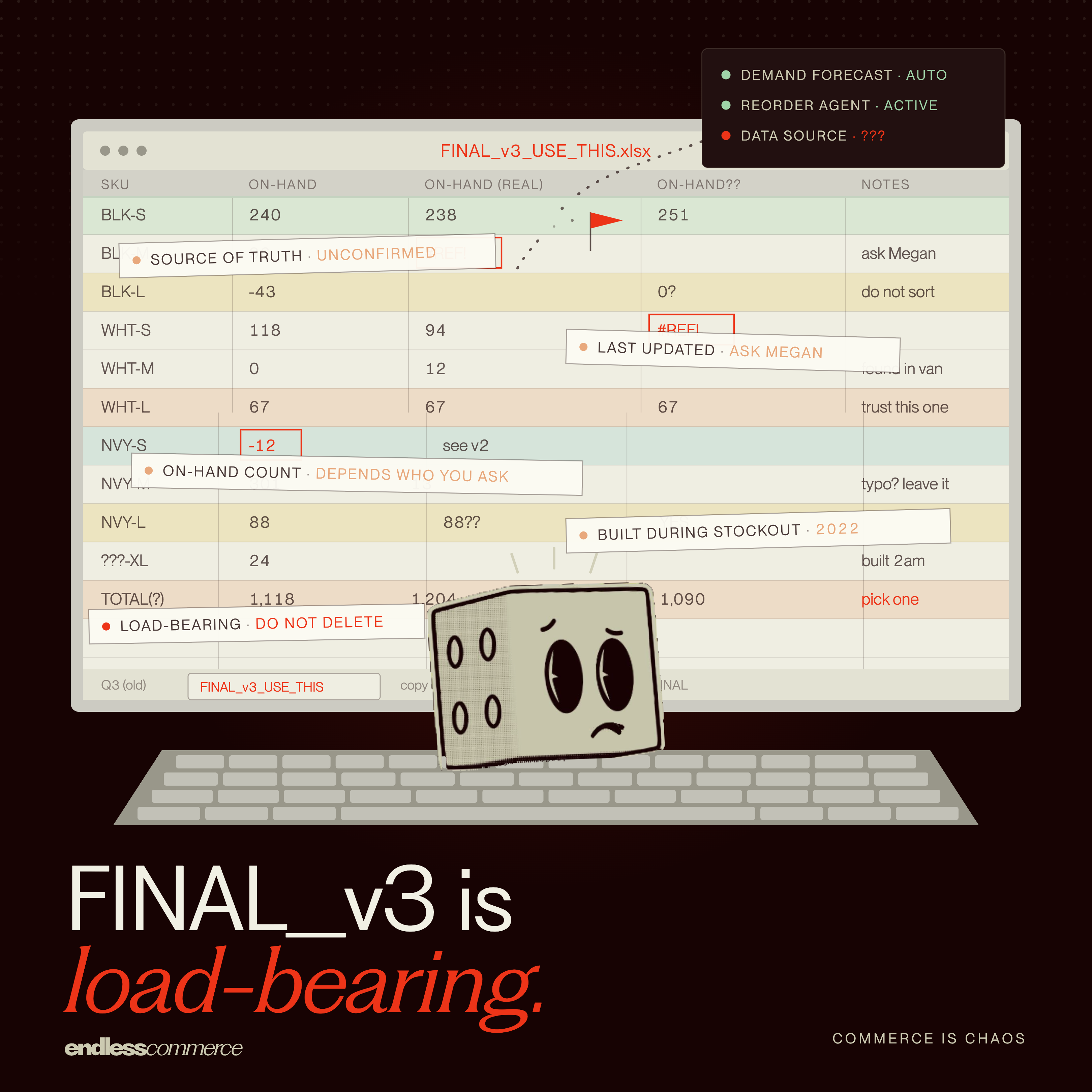
There’s a moment on most operations calls where someone goes quiet, opens a tab they were hoping not to open, and reads a number off a spreadsheet. The file is named something like inventory_master_FINAL_v3_USE_THIS. Somebody built it during a stockout in 2022 and it never left. It is now the most load-bearing object in the company.
I think about that spreadsheet constantly, because right now the entire industry is trying to sell the person who maintains it on artificial intelligence.
Open any commerce trend list for this year and you’ll find the same word: enablement. AI enablement, commerce enablement, agentic this, autonomous that. The pitch is seductive and basically identical everywhere. Your operation runs itself. Your forecasts write themselves. Your reorders happen before you’ve noticed you needed them. Demand planning on autopilot, an agent watching your supply chain while you sleep. Wheeeee!
I want it to be true. I also know what’s sitting underneath most of these companies, because I’ve been in the back office, and it’s that spreadsheet.
Here’s the part the enablement crowd skips: every one of those magic capabilities is a function of data you already don’t trust. A forecast based on that garbage is just an over-confident statement about numbers. I see you, you liar. If your on-hand count disagrees with itself across your 3PL, your store POS, and your marketplace listings — and it does, for almost everyone — then the forecast isn’t intelligence, nope nope nope. It’s a very expensive guess, dressed up like a sports official blowing a whistle wearing the number “81” on their jersey (get it, eight-eye? AI?). Ok I’m tired and not at my creative peak, that was a stretch. But the point is:
You can stack the smartest model in the world on top of bad inventory data and all you’ve built is a faster way to be wrong. LOL.
Hear me out. This is a thing operators have always known. AI shillers keep pretending they can get past it. They can’t. Well, I guess they can. But you shouldn’t.
So when people ask me what “commerce enablement” actually means, I’ve stopped giving the brochure answer. Enablement isn’t the AI layer on top. Nope nope nope. Enablement is the boring substrate underneath. One place where your catalog, your inventory, your orders, and your fulfillment agree with each other, in real time, without a human reconciling tabs at 11pm. That’s it. That’s the whole unglamorous miracle. Everything the industry is excited about — forecasting, anomaly detection, agents that route exceptions before they become fires — only works if that foundation is true. Most brands are being sold the roof before anyone’s poured the floor. (That was better than my sports analogy, right?)
You can run the test yourself, and it’s bruuuutal. Pick one SKU. Ask three different people in your company how many units you have right now. If you get three different answers, you are not enabled. You’re hopeful. There’s a difference, and the difference is exactly the gap every shiny tool will faceplant into the second you turn it on.
The good news is that the brands actually pulling ahead this year already figured this out, and they’re not doing anything flashy. They’re not chasing every new agent or channel. They probably simplified. They surely connected the systems that mattered and killed the ones that didn’t. They made sure their numbers were true first, and then the clever stuff started working, because there was finally something solid to be clever about. It’s the least viral strategy in commerce. It also happens to be the one that works.
I think the reason nobody talks about this is that foundation work is unsexy and the AI demo is not. Nobody films a launch video about finally deleting FINAL_v3. But that’s the actual job. The agent doesn’t save you. The clean substrate that lets the agent be trusted with a decision is what saves you. The intelligence is downstream of the plumbing, and it always has been.
So if you’re sitting in budget meetings this year getting pitched enablement, please-for-the-love-of-yourselves push on one question before any of the fun ones: if I asked my own team how much of anything I have, would they agree?
Get that to yes, ok? Then everything else gets easier. And you finally get to close the spreadsheet.
xoxo,
Chaos